Local and regional newspapers, many of them more than 100 years old, going out of business. Broadcast media shrinking. Online startups folding after blowing through millions of dollars in initial funding. And throughout the industry, journalists losing jobs.
In recent years, through its Local News Initiative, the Medill School of Journalism, Media, Integrated Marketing Communications has gone beyond its traditional role of undergraduate and graduate education, launching a number of outreach programs to assist media professionals in combating the industry’s troubling trends and to help high schools educate young journalists.
“The role of the modern journalism school cannot simply be the training of future journalists and marketers. The industries that we serve are in such turmoil that if our students are to have jobs, to have industries to go into, those industries need leadership, research and someone from outside the industry to help them think outside of the box and chart a path forward,” said Medill Dean Charles Whitaker. “So it’s in our vested interest to step outside of what our traditional role was and provide the leadership, the innovation, the creative thinking to enable these organizations and entities to continue. Otherwise, if they implode and cease to function, there will be no place for our students to go.”
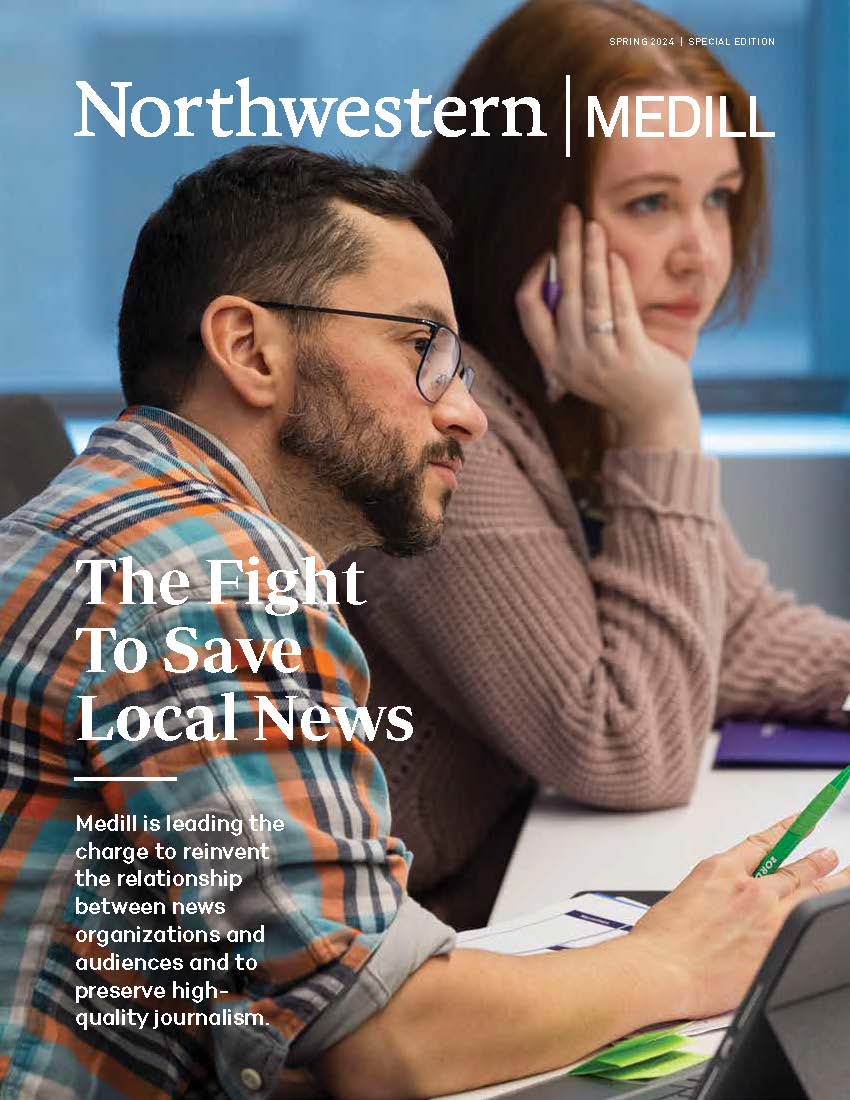
This special edition of the Medill magazine takes a look at the Local News Initiative and its outreach programs.
If you want to know the state of journalism in the U.S. today, your best source is the website of Medill’s Local News Initiative, localnewsinitiative.northwestern.edu.
From the sobering info contained in an annual report on the state of local news to success stories that illustrate what’s working, the site provides an up-to-date look at the journalism industry. But for those willing to drill a bit deeper, the site also details the pathbreaking work of the Local News Initiative, a key project of Medill.
Founded in 2017, the LNI is an innovative research and development project with the goal of reinventing the relationship between news organizations and audiences while developing new approaches to local news business models. The LNI is led by Professor Tim Franklin, Senior Associate Dean and John M. Mutz Chair in Local News and Director of the Medill Local News Initiative. Franklin came to Medill from the Poynter Institute after a distinguished career in which he served as the top editor of The Indianapolis Star, Orlando Sentinel and Baltimore Sun.
“A goal of the Local News Initiative is to do what Medill and a university can uniquely do: impactful research about the
local news industry and local news audiences,” Franklin said.
Unquestionably the most visible product of the LNI has been its annual report on the state of local news, which is led by Visiting Professor Penny Abernathy. The 2023 report, which came out last November, garnered headlines across the country with its grim finding that the U.S. was losing 2.5 local newspapers a week and that 204 counties now have no access or very limited access to local news — “news deserts.” In addition, using metrics developed by Medill’s data scientists, researchers and faculty members, the report identified another 228 counties at risk of becoming news deserts.
However, the report, the LNI website, and the LNI itself now also shine a light on local news bright spots, those media outlets that are succeeding in attracting audiences, doing high-quality journalism — and even making money — in today’s challenging media environment. Creating more of those successes is also a key goal of the LNI.
“We want people to know the challenges around local news — and they are considerable — but we also want to be inspiring new ideas to help local news outlets figure out new business models going forward. And we want to work directly with news organizations to help them become sustainable over the long term,” Franklin said.
To do that, the LNI has created or expanded a number of programs aimed at bolstering local news (see related stories on following pages). While a number of the programs are focused on the Chicago area, the LNI’s research and work includes news organizations across the U.S. The Medill Subscriber Engagement Index, done in conjunction with the Spiegel Research Center, includes more than 100 news organizations from across the country and provides local digital readership and benchmarking data to new outlets big and small for free.
In doing so, Medill hopes to develop models for local news that, while probably different from what media have done in the past, will enable journalism to continue to benefit society, said Dean Charles Whitaker.
“Is that possible? I absolutely think it’s possible. Do I think we’re going to save local news as it has traditionally existed? No. But the goal is to determine what local news and journalism should look like in the rest of the 21st century,” Whitaker said.
“The goal is to preserve vehicles of information that will function as a way for our communities to see themselves, that will serve as another pillar of democracy that will be a bulwark against authoritarianism,” Whitaker added. “I’m agnostic about what form that takes, I just want us to help figure out what that form is. The goal is to ensure local
news, a reliable source of credible information that citizens can turn to, that we can agree upon and that is trusted by everyone, in order to preserve democracy.”
Support for the Local News Initiative and the launch of its programs has come from major grants from the McCormick Foundation, Knight Foundation, Lilly Endowment, other foundations and significant gifts from John Mutz (BSJ57, MSJ58) and Mark Ferguson (BSJ80). Medill now is seeking additional funding from other organizations and from alumni.
After an initial grant of $300,000 from the Lilly Endowment and the Mutz gift, the Robert R. McCormick Foundation made a grant of $1 million in 2019 and then followed up with a $2.4 million grant in 2022 to launch the Local
News Accelerator.
In addition to Lilly and McCormick, the Local News Initiative has received grants and gifts from the Knight Foundation, MacArthur Foundation, Joyce Foundation, Microsoft, Google, SNPA Foundation, Myrta Pulliam Charitable Trust and the KAS USA Foundation.
In 2017, Mutz contributed $250,000 to help launch the Local News Initiative and then followed up with a $2 million gift in 2020 to endow a professorship in local news. Tim Franklin,
Medill’s senior associate dean and professor, is the John M. Mutz Chair in Local News and the Director of the Local News Initiative.
While a student at Medill, Mutz worked on the copy desk at the Indianapolis News. However, he did not go into journalism, entering politics after a short stint in public relations. He served in the Indiana legislature and was elected lieutenant governor of the state before then going into private business and philanthropy. He was the president of PSI Energy, the largest utility in Indiana, and then headed the Lilly Endowment Inc., one of the world’s largest private foundations. Two of Mutz’s children and two of his grandchildren also graduated from Northwestern.
“One of the things that the Lilly Endowment did when I was president was to encourage the creation of community foundations and we eventually seeded enough community foundations in every county in Indiana. That involvement, as well as running for office, made it crystal clear to me how important a reliable, sustainable — and I might say profitable — local news source is for a community,”
Mutz said.
To make a gift or for more information on how to support the Local News Initiative programs, contact Kyle Daniels, associate director of development, at kyle.daniels@northwestern.edu or 847.467.3736.