Categories
Home Medill News

Medill Launches New Military Reporting Project

Medill is launching a Military Reporting Project in collaboration with the 1st Infantry Division at Ft. Riley, Kan., giving students a rare opportunity to report while embedded with troops.

As part of this partnership, students will be periodically embedded with 1st Infantry service members at Ft. Riley and on a European deployment.

The pilot program, which will run through August 2027, is being funded with a grant from the Robert R. McCormick Foundation.

“This is an incredible opportunity for a select group of Medill students to learn the basics of military reporting and storytelling up close with 1st Infantry active-duty soldiers who are in training and deployed overseas,” said Medill Dean Charles Whitaker. “We’re grateful to the leadership at the 1st Infantry Division and the McCormick Foundation for making this unique opportunity available to our students.”

This collaboration comes as Medill’s Local News Initiative recently documented the severe lack of coverage of military bases in the U.S. In the last 20 years, newspapers near military installations have disappeared at a rate four times the national average. And in the outlets that remain near bases, there has been a 40% decrease in the number of stories about military issues, according to the report authored last month by Zach Metzger, director of the State of Local News Project.

Spearheading the program for Medill will be Colin McMahon, the former editor-in-chief of the Chicago Tribune and chief content officer of Tribune Publishing. As a foreign correspondent for the Tribune, McMahon covered the war in Iraq and armed conflicts in Kosovo, Chechnya, Afghanistan, and other regions.

McMahon also served as the Tribune’s correspondent in Moscow, Mexico City, and South America, based in Buenos Aires. Most recently, McMahon has been working as a consultant and coach working with local newsrooms on strategy.

McMahon will teach and direct the students in the program. The student journalists will report, write and create multimedia stories for internal Ft. Riley publications as well as for independent news organizations. McMahon also will serve as Medill’s liaison with the leadership at Ft. Riley.

“Robert R. McCormick fought with the U.S. Army’s 1st Infantry Division during World War I and provided some of the initial funding for Medill,” said Timothy P. Knight, McCormick Foundation CEO. “This project joins these two outstanding organizations in doing some very important work, and we are delighted Colin McMahon will be leading it.”

The First Division Museum, dedicated to the 1st Infantry Division, is located at Cantigny, Col. McCormick’s former estate in Wheaton. McCormick served as publisher, editor-in-chief, and principal owner of the Chicago Tribune over four decades before his death in 1955.

The 1st Infantry is “proud to partner with the Medill School of Journalism to strengthen the next generation of storytellers,” said Lt. Col. Guster Cunningham III, public affairs officer, 1st Infantry Division, spokesman for the division on behalf of its commanding general, Major General Mont`e L. Rone.

“This collaboration gives students an authentic look at how America’s Army communicates with discipline, transparency, and purpose,” Cunningham said. “Together, we’re building a learning environment that elevates public trust and prepares future journalists to cover national security with accuracy and depth.”
Categories
Home My Medill Story

Jonah Dylan (BSJ20) A strong reporter versed in many areas of the field

By Sasha Baumgartner (BSJ28)

Jonah Dylan is a Sports Reporter at The Commercial Appeal 

This interview has been lightly edited for brevity and clarity. 

What has your path been since graduation? 

I was just looking for anywhere to get my start in journalism. Ended up getting an internship opportunity at the Las Vegas Review Journal. I think I was an intern for 5 or 6 months and then got a job as a breaking news reporter, mostly covering crime. I ended up staying there for in total, a year and three months and decided I wanted to move away from crime and breaking news and into a different type of reporting. So I ended up getting a job in Connecticut with Hearst, a website called CT Insider. Moved to Hartford Connecticut and covered local government and city hall in Hartford for about a year and that was obviously super different from the breaking news stuff. It was building relationships and definitely a different type of reporting but I enjoyed it.

How did you end up in your current role? 

I wanted to try sports reporting, which was something that I’d done when I was in college. I started looking for those types of jobs and basically just kind of applied for everything I saw and tried to find connections, hoping for the best. Obviously it’s really difficult. I got what I still think was really lucky with this job in Memphis. I didn’t know anyone at the newspaper. So I just kind of sent my resume and my clips and got really lucky that they took a chance on me because I was applying for a sports reporting job without any professional sports reporting experience. I was able to use my experience doing other stuff and show them how it would help me in that job. So I moved to Memphis. It was about three years ago. I cover the University of Memphis football team and I kind of help out on everything else.

What are some things from past jobs that helped you move into sports reporting? 

Sports is one of those things where you can cover a sports story but it always bleeds into everything else. For example, when I first moved to Memphis, one of the biggest stories in the city was they were trying to renovate both the football stadium and the basketball arena. So a lot of that story had to do with funding, which was coming from city council. The place where the story was happening was in city council meetings and for a lot of places that would’ve meant the city council reporter was on it even though it connected to other stuff. But I had come from a place where I had just been covering city council. But it was easier for me to take over that job, essentially the beat because I was comfortable talking to city councilors, reading meeting agendas and where to go during the meeting and where to pay attention to.

How did Medill help prepare you for these roles?

It gave me exposure to a lot of different things, which is obviously important. Being able to take different classes that you don’t really know at the time when this is going to help you, how it’s going to matter. You can kind of be in a random situation somewhere, reporting on something and it’ll pop into your head. Kind of like ‘oh I remember I learned this in this class, or I experienced this when I was doing something.’  For me, The Daily was my main thing and I spent way too many hours there and most of my life. But that’s basically where I learned everything that I know how to do as a journalist. Both just in terms of having to do it and also from the people that I was around when I was doing that.

What advice would you have for anyone that’s currently at Medill? 

Do as many things as possible. Take advantage of all the opportunities. The best thing I did when I was in Medill was my JR in South Africa and that was a huge thing in my life and in my career. I’m so happy that I did that because of the experience that I had, not only just life experience of living in Cape Town, but also the journalistic aspect of it, like figuring out a new place through journalism. Journalism is actually a great way to get to know a place because you’re almost incentivized to ask people things about the city that you don’t know anything about.

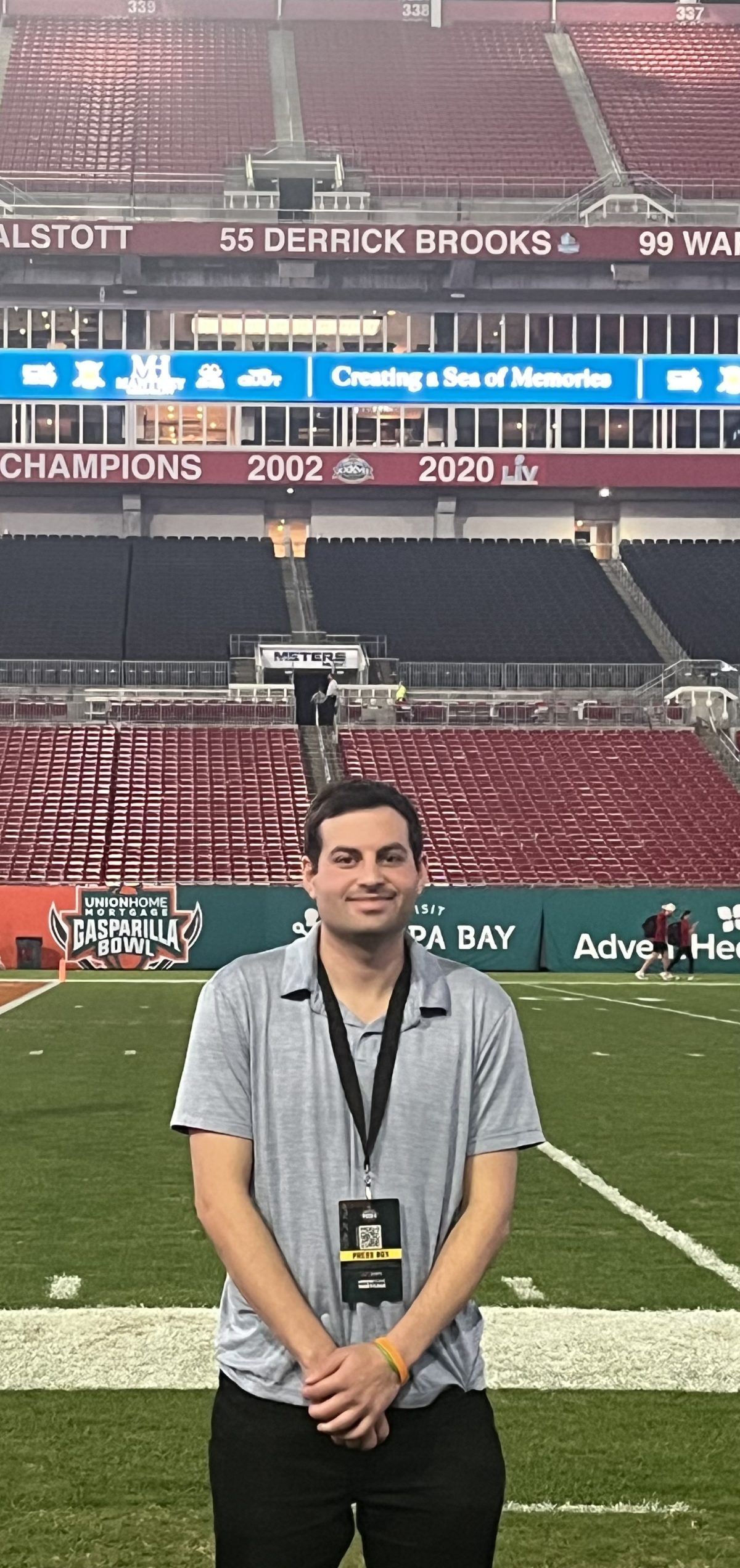
Commercial Appeal reporter Jonah Dylan at the Gasparilla Bowl on Dec. 19, 2025.